
SYS means systolic blood pressure, DIA means diastolic blood pressure, and PUL means pulse rate. These labels identify the main readings on many digital blood pressure monitors.
For example, a display showing SYS 120, DIA 80 and PUL 72 means your blood pressure is 120/80 mmHg and your pulse is 72 beats per minute.
Here’s how to read those numbers, measure consistently, and understand when to seek medical advice.
What Do the Numbers on a Blood Pressure Monitor Mean?
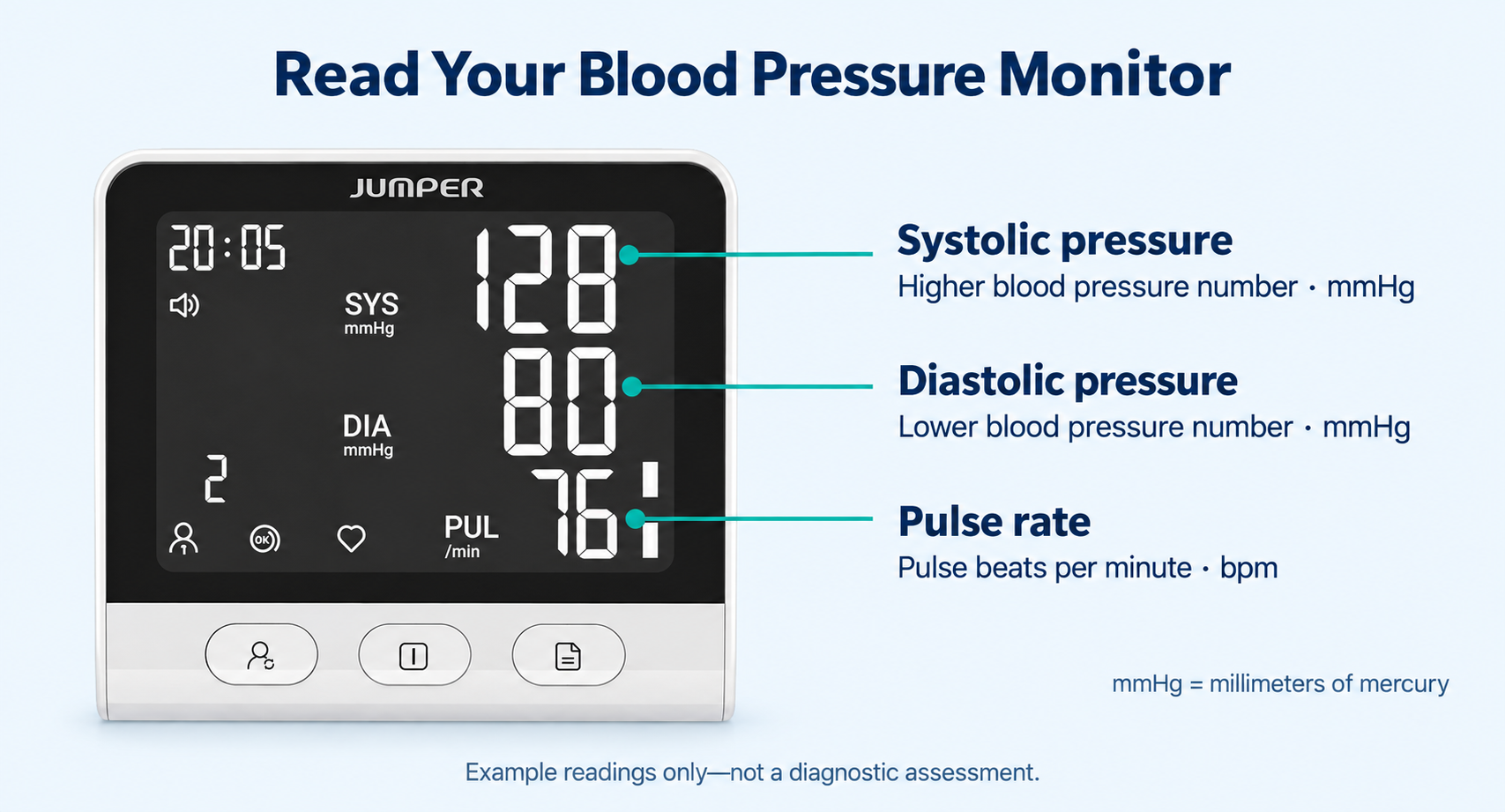
| Display label | Meaning | How to read it |
|---|---|---|
| SYS | Systolic blood pressure | The higher blood pressure number, measured in mmHg |
| DIA | Diastolic blood pressure | The lower blood pressure number, measured in mmHg |
| PUL or PULSE | Pulse rate | The number of pulse beats per minute, often shown as bpm |
mmHg stands for millimeters of mercury, the unit used to measure blood pressure. bpm means beats per minute.
For the example above, you would say: “Blood pressure is 120 over 80, with a pulse of 72.”
Check your monitor’s labels and instructions rather than identifying a reading only by its position on the screen.
What Is the Difference Between Systolic and Diastolic Pressure?
Blood pressure is the force of blood against your artery walls. It rises and falls as your heart contracts and relaxes.
Systolic pressure is the peak arterial pressure when your heart contracts and pumps blood. It is the first number in a reading such as 120/80 mmHg.
Diastolic pressure is the lowest arterial pressure during the relaxation phase between heartbeats. It is the second number.
“Higher” and “lower” describe these two measurements. They do not, by themselves, mean you have high or low blood pressure. 1
How Should I Interpret My Blood Pressure Reading?
Interpret repeated readings using the guideline recommended by your healthcare professional. A single measurement usually cannot confirm hypertension, and home readings may have different thresholds from clinic readings.
Guidelines also differ internationally. These examples show why online blood pressure charts do not always agree:
| Guideline and setting | Hypertension threshold |
|---|---|
| U.S. AHA/ACC, 2025 — office classification | Systolic ≥130 or diastolic ≥80 mmHg |
| European ESC, 2024 — office measurement | Systolic ≥140 or diastolic ≥90 mmHg |
| European ESC, 2024 — average home measurement | Systolic ≥135 or diastolic ≥85 mmHg |
These are selected guideline examples, not a universal classification. They apply to properly obtained, repeated measurements. Either number can meet the threshold; both do not have to be elevated. 2 3
A result below a hypertension threshold is not automatically an ideal result. Your personal treatment target may also differ from the threshold used for diagnosis.
Why Do My Readings Change Each Time?
Blood pressure naturally varies. Recent activity, talking during measurement, posture, and cuff fit can also affect the result.
Two different readings do not automatically mean your monitor is faulty. Following the same measurement routine helps make your results more comparable.
Before You Measure
- Avoid smoking, caffeine, and exercise for at least 30 minutes.
- Empty your bladder.
- Rest quietly for five minutes.
While You Measure
- Sit with your back supported and feet flat on the floor.
- Keep your legs uncrossed.
- Place a correctly sized cuff on your bare upper arm.
- Support your arm so the middle of the cuff is at heart level.
- Stay still and do not talk.
Reading your monitor starts with understanding SYS, DIA and pulse. Making the results useful requires correct technique, complete records, and interpretation of the pattern over time.
Bring your readings to your healthcare professional and follow the guidance appropriate to your health and location. Do not change prescribed medication based on home readings without medical advice. 4
This article provides general information for adults. Children and pregnant people require assessment using specific clinical guidance.
References
- Muntner P, Shimbo D, Carey RM, et al. Measurement of Blood Pressure in Humans: A Scientific Statement From the American Heart Association. Hypertension. 2019;73(5):e35–e66. doi:10.1161/HYP.0000000000000087
- Jones DW, Ferdinand KC, Taler SJ, et al. 2025 AHA/ACC multisociety guideline for the prevention, detection, evaluation, and management of high blood pressure in adults. Circulation. 2025. doi:10.1161/CIR.0000000000001356
- 2024 ESC Guidelines for the management of elevated blood pressure and hypertension. European Heart Journal. 2024;45(38):3912–4018. Read guideline
- Parati G, Stergiou GS, Bilo G, et al. Home blood pressure monitoring: methodology, clinical relevance and practical application: a 2021 position paper by the Working Group on Blood Pressure Monitoring and Cardiovascular Variability of the European Society of Hypertension. Journal of Hypertension. 2021;39(9):1742–1767. doi:10.1097/HJH.0000000000002922
- Flint AC, Conell C, Ren X, et al. Effect of Systolic and Diastolic Blood Pressure on Cardiovascular Outcomes. The New England Journal of Medicine. 2019;381:243–251. doi:10.1056/NEJMoa1803180