
You take your temperature with a forehead thermometer and get 35.9°C. A few minutes later, you try again and see 36.5°C. Or perhaps the reading seems unusually high even though you feel fine.
So, is your forehead thermometer inaccurate? Not necessarily. Forehead thermometer readings can be affected by several factors, including the measurement environment, the condition of the forehead, measurement distance and position, recent physical activity, and how the thermometer is being used.
Understanding these factors can help explain unexpected readings and improve the consistency of your temperature checks.
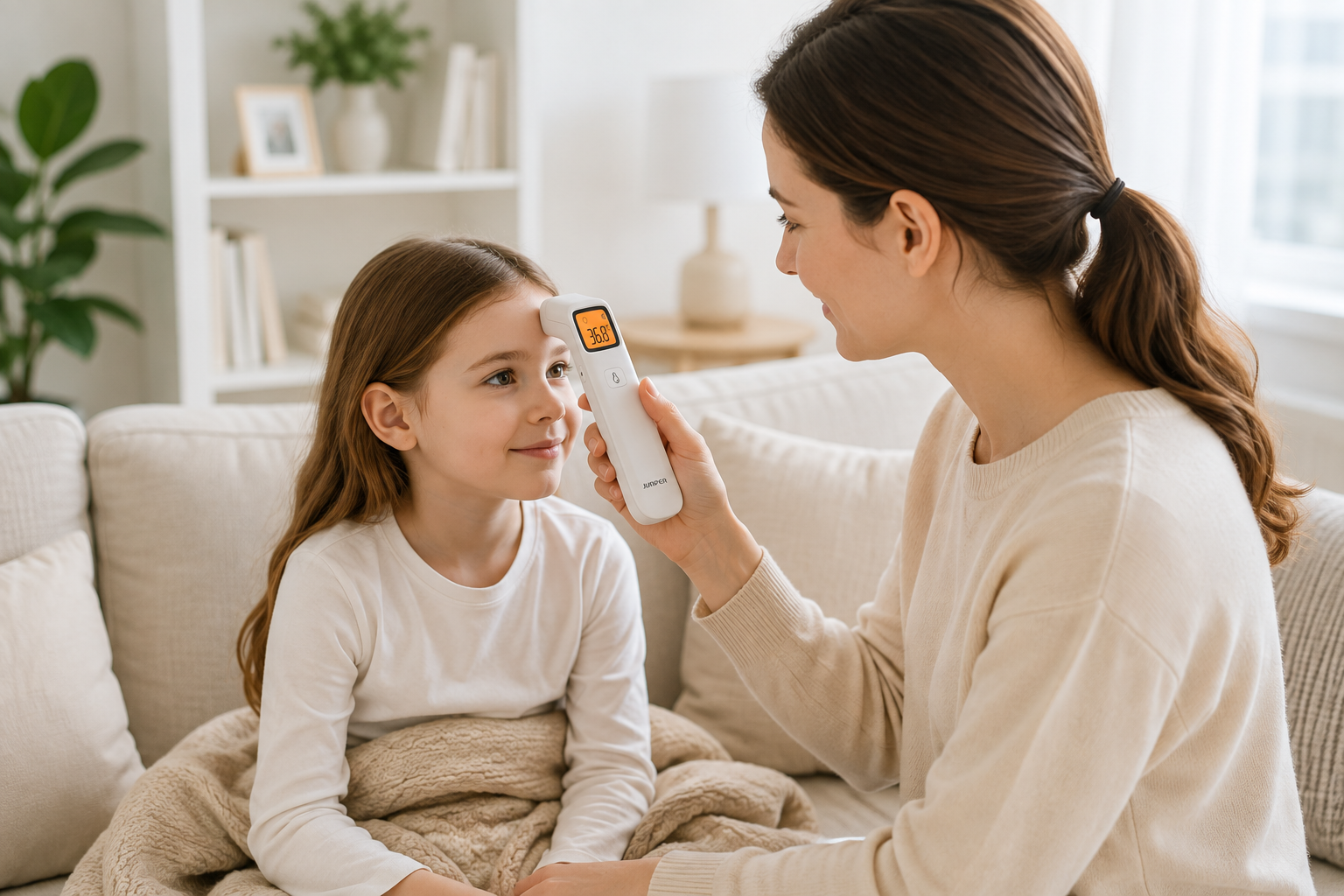
Why Can Forehead Thermometer Readings Vary?
Non-contact infrared forehead thermometers do not directly measure core body temperature. Instead, an infrared sensor detects thermal radiation emitted from the surface of the forehead.
The device then processes this information to provide a temperature reading. Depending on the thermometer, its internal algorithm may compensate for differences between forehead surface temperature and a reference body temperature.
Because the measurement starts at the skin surface, environmental conditions and measurement technique can influence the result. This is why correct use matters.
7 Reasons Your Forehead Thermometer May Read Low or High
The Measurement Distance Is Incorrect
One of the most common mistakes when using a non-contact forehead thermometer is holding it at the wrong distance.
Infrared thermometers are designed to operate within a specific measurement distance. Holding the thermometer too far away, or using it differently from the manufacturer's instructions, may affect the reading.
What to do: Check the instructions for your specific thermometer and maintain the recommended measurement distance each time.
The Forehead Is Sweaty, Wet, or Covered
The condition of the forehead matters. Sweat, moisture, hair, hats, headbands, or other materials covering the measurement area can interfere with temperature measurement.
What to do: Make sure the forehead is clean, dry, and free from hair or coverings before measuring.
The Environment Has Changed
Infrared thermometers can be sensitive to their operating environment. Moving between a cold outdoor environment and a warm room, or vice versa, can temporarily affect both the person's forehead temperature and the thermometer itself.
Direct sunlight, heating sources, strong drafts, and significant changes in room temperature may also affect measurement conditions.
What to do: Measure in a stable indoor environment, away from direct sunlight, strong airflow, or radiant heat.
You Recently Exercised, Bathed, or Came Indoors
Exercise can temporarily increase body temperature. A hot bath or shower may also affect temperature, while exposure to cold outdoor conditions may change the temperature of the forehead.
What to do: Avoid taking a reading immediately after activities or environmental exposure that may temporarily change body or skin temperature. Follow your thermometer's instructions for any recommended waiting period.
The Thermometer Is Positioned Incorrectly
Correct positioning is just as important as correct distance. If the thermometer is angled incorrectly or aimed at the wrong area, the infrared sensor may detect thermal radiation differently.
What to do: Aim at the recommended measurement area, keep the thermometer steady, and follow the positioning instructions provided with your device.
The Infrared Sensor Is Dirty
Dust, dirt, moisture, oil, or fingerprints on the sensing area may interfere with infrared detection.
What to do: Inspect the sensor regularly and clean the thermometer only according to the manufacturer's cleaning instructions.
The Thermometer Is Not Being Used as Intended
Some infrared thermometers include more than one measurement mode, such as body temperature and object or surface temperature. These modes may process infrared information differently.
Other issues, such as a low battery or operating the thermometer outside its specified environmental conditions, may also affect performance.
What to do: Confirm that the thermometer is in the correct body-temperature mode and follow the manufacturer's instructions.
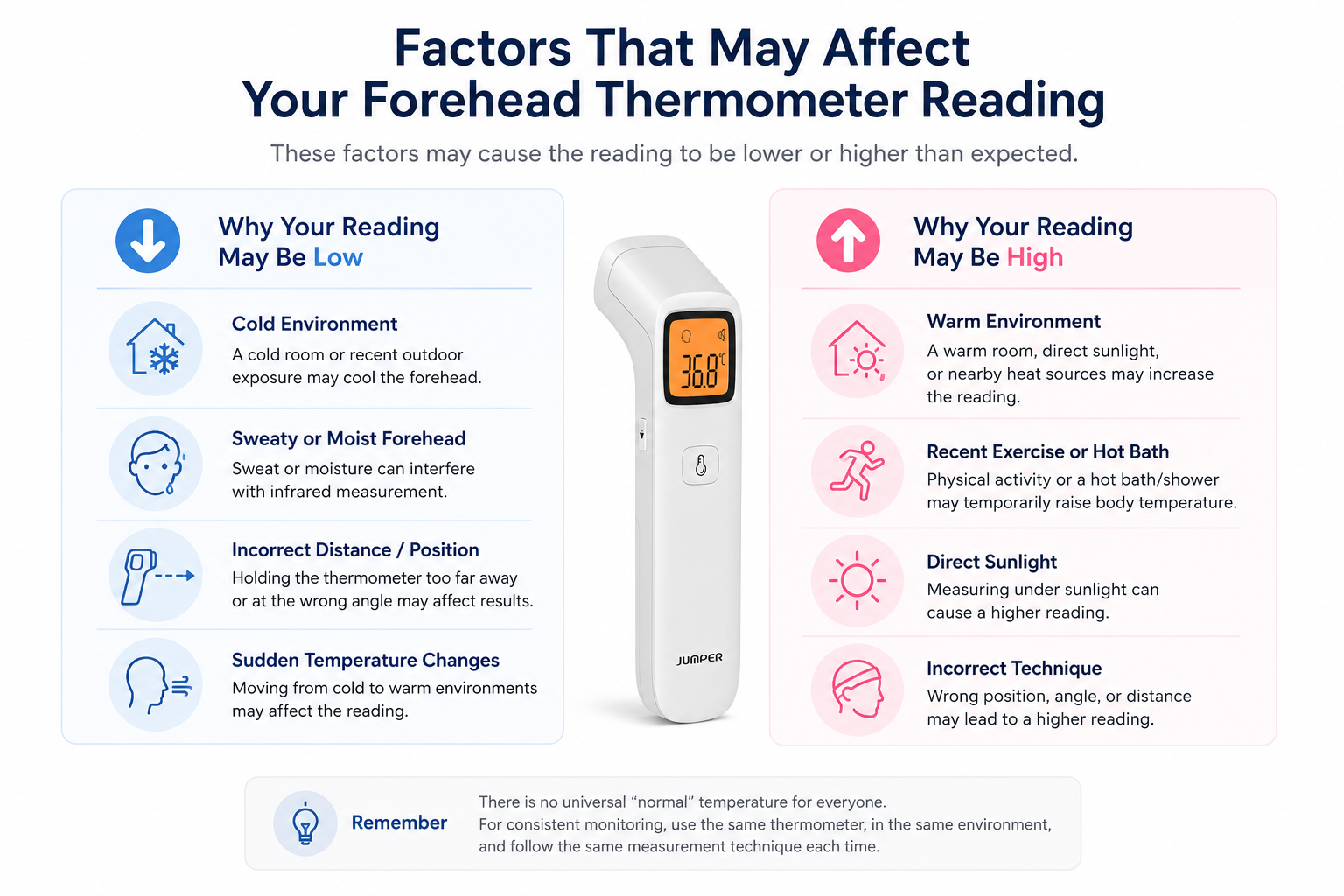
Why Is My Forehead Thermometer Reading Too Low?
If your forehead thermometer consistently shows a temperature lower than expected, don't immediately assume the device is defective.
Several measurement conditions may contribute to an unexpectedly low reading, including a cool forehead after being outdoors, sweat or moisture on the skin, incorrect measurement distance, incorrect sensor positioning, an unsuitable measurement environment, or use of the wrong measurement mode.
It is also important to remember that temperature readings from different parts of the body are not necessarily identical.
If you are monitoring temperature over time, consistency matters. Whenever possible, use the same thermometer, measurement site, environment, and technique.
Why Is My Forehead Thermometer Reading Too High?
An unexpectedly high reading can also have several possible explanations.
Recent exercise, a hot bath, heavy clothing or head coverings, exposure to a warm environment, or incorrect measurement technique may affect the conditions under which a forehead temperature is taken.
If a reading is unexpected, repeat the measurement carefully according to the manufacturer's instructions. If the result remains elevated or the person has concerning symptoms, consider confirming the temperature using an appropriate method and seek medical advice when necessary.
Avoid applying a fixed correction such as adding or subtracting 0.5°C from a forehead reading. Different measurement sites do not have a universal conversion formula.
How to Get a More Reliable Forehead Temperature Reading
A few simple steps can improve measurement consistency.
- Use the thermometer in a stable indoor environment.
- Avoid direct sunlight, strong drafts, or nearby heat sources.
- Make sure the forehead is clean, dry, and uncovered.
- Select the correct body-temperature mode.
- Aim at the measurement area specified by the manufacturer.
- Maintain the recommended measurement distance.
- Keep the infrared sensor clean and dry.
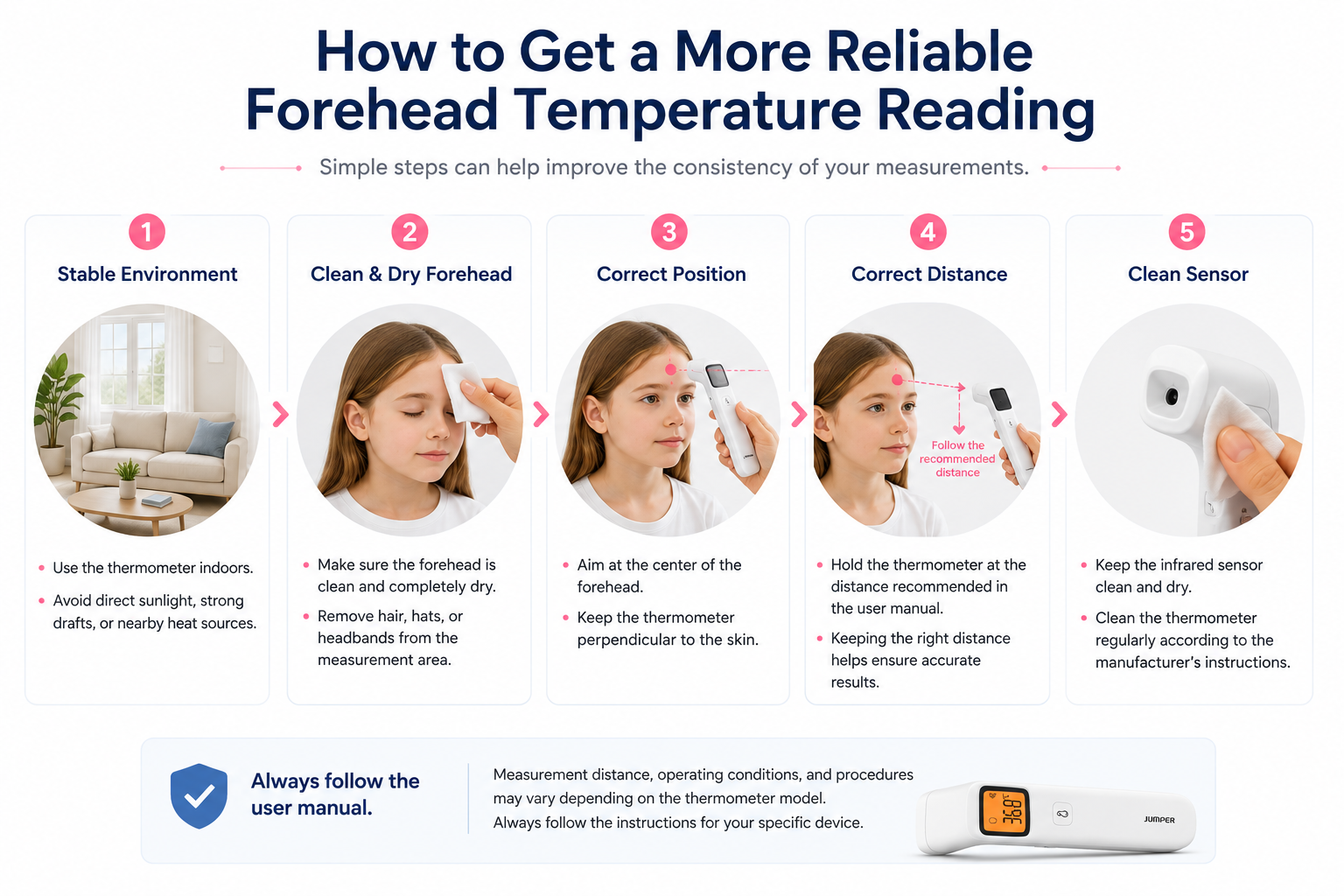
The most important rule is simple: always follow the instructions for your specific thermometer. Different infrared thermometers may have different measurement distances, operating environments, modes, and procedures.
Why Do I Get Different Forehead Temperature Readings Each Time?
Small differences between repeated measurements do not automatically mean something is wrong with the thermometer.
For example, you might see: 36.4°C → 36.6°C → 36.5°C.
The exact measurement location, distance, angle, environment, and normal measurement variation can all contribute to small differences.
To improve consistency, keep as many conditions as possible the same: same thermometer + same location + same distance + same environment + same technique.
Forehead vs. Ear Temperature: Should the Readings Be the Same?
Not necessarily.
Forehead and ear thermometers measure temperature at different anatomical sites, and readings from different sites should not be expected to match exactly.
Ear thermometers measure infrared energy inside the ear canal, while forehead thermometers measure infrared energy from the forehead or temporal area.
There is no universal number that should simply be added to or subtracted from one measurement method to make it equal another.
When monitoring changes in temperature, it is generally more useful to compare readings taken consistently using the same method.
When Should You Double-Check a Temperature Reading?
A forehead thermometer is convenient for quick temperature checks, but a single number should always be considered together with the person's overall condition.
Consider repeating or confirming a measurement when:
- The reading seems inconsistent with how the person feels.
- Repeated measurements vary substantially.
- The reading is unexpectedly high or low.
- The thermometer may have been used incorrectly.
- Measurement conditions were unsuitable.
- A very young infant may have a fever.
- The person has concerning or worsening symptoms.
JUMPER FR203 Non-Contact Forehead Thermometer
The JUMPER FR203 is designed for convenient, non-contact temperature measurement for everyday home use.
- Non-contact temperature measurement
- Easy-to-read display
- Simple everyday operation

Frequently Asked Questions
Why does my forehead thermometer read lower than expected?
A lower-than-expected reading may be related to environmental conditions, a cool or sweaty forehead, incorrect measurement distance or positioning, or improper use of the thermometer.
Can a forehead thermometer give a falsely high reading?
Measurement conditions can affect a forehead thermometer reading. Recent exercise, bathing, environmental heat, forehead coverings, or improper measurement technique may influence the result. However, an elevated reading should not automatically be dismissed as inaccurate.
Does room temperature affect a forehead thermometer?
Environmental conditions can affect non-contact infrared thermometer performance. Use the thermometer within the operating conditions specified by the manufacturer and avoid direct sunlight, strong drafts, or radiant heat during measurement.
Why does my forehead thermometer give different readings every time?
Small variations may occur because of changes in measurement position, distance, angle, environment, or normal measurement variability. Using the same technique and measurement conditions can improve consistency.
Should forehead and ear temperature readings be the same?
No. They are different measurement methods and should not be expected to produce identical results. It is generally more useful to compare temperature trends using the same measurement method.
Should I add or subtract degrees from a forehead thermometer reading?
No universal correction should be applied. Different measurement sites can produce different readings, and there is no exact conversion that applies to every person and thermometer.