
When choosing a fetal Doppler, you may notice that different devices use different ultrasound probe frequencies, most commonly 2 MHz, 2.5 MHz, or 3 MHz.
Does a higher frequency mean better fetal heart detection?
Not necessarily.
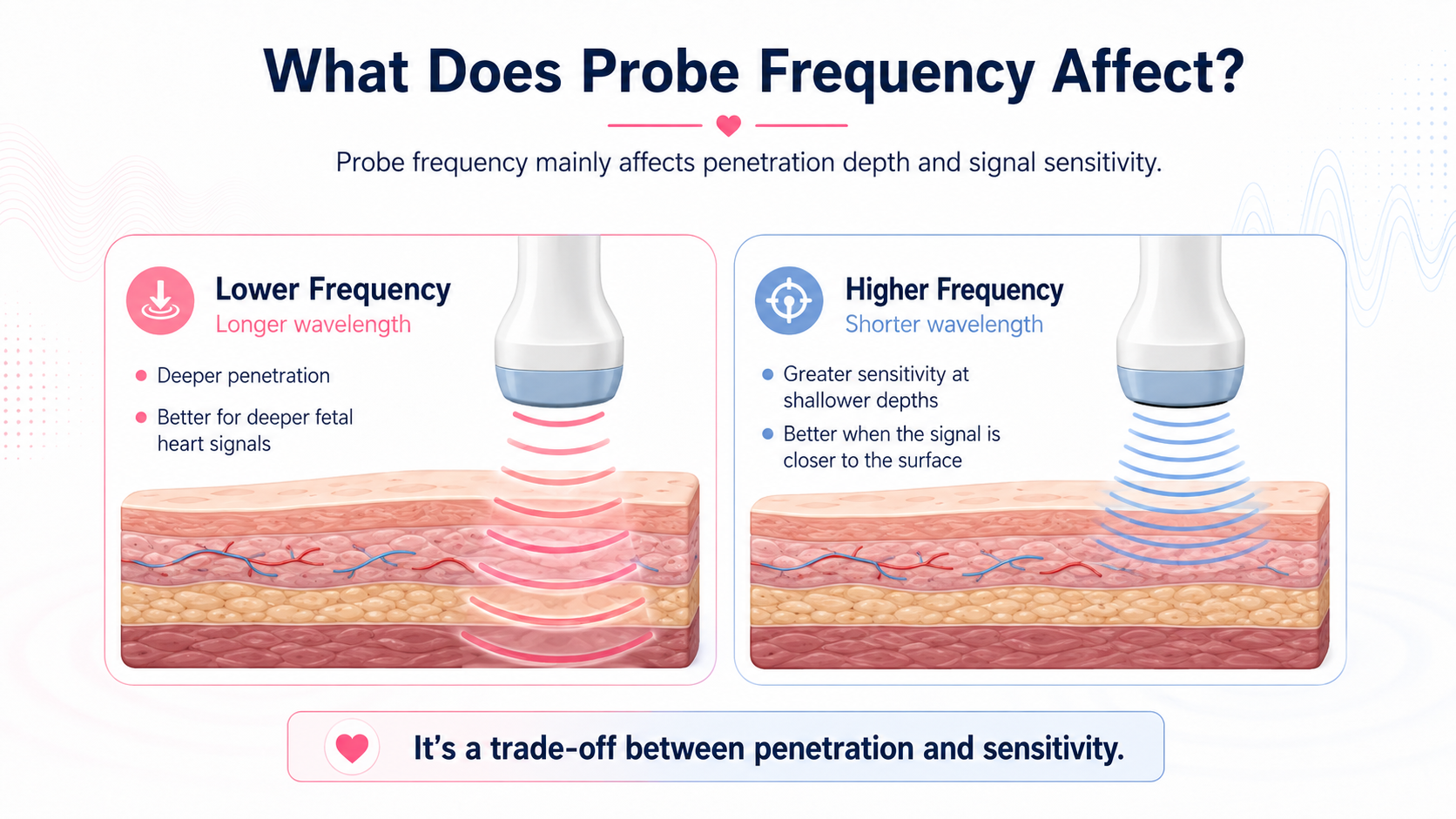
Probe frequency mainly affects the balance between ultrasound penetration depth and sensitivity at different tissue depths. Each frequency has its own characteristics, and the appropriate choice depends on the detection scenario rather than simply selecting the highest number.
What Does Fetal Doppler Frequency Mean?
A fetal Doppler uses ultrasound waves to detect movement associated with the fetal heart and converts the Doppler signal into an audible heartbeat and, in many devices, a fetal heart rate reading.
The frequency shown in the product specifications — such as 2 MHz, 2.5 MHz, or 3 MHz — refers to the operating frequency of the ultrasound probe.
In general:
Lower frequency → greater penetration
Higher frequency → greater sensitivity at shallower depths
This creates a trade-off between penetration and sensitivity.
That is why 2 MHz, 2.5 MHz, and 3 MHz probes can all be used for fetal heart detection while offering different strengths.
2 MHz Fetal Doppler: Deeper Penetration
A 2 MHz fetal Doppler probe uses a relatively lower ultrasound frequency.
Its main advantage is greater penetration through tissue, making it useful when the fetal heart signal is located deeper.
Key characteristics of 2 MHz
- Lower ultrasound frequency
- Greater tissue penetration
- Useful for deeper fetal heart signals
- Commonly used as a general-purpose obstetric Doppler frequency
Importantly, 2 MHz should not be considered a frequency that is only suitable for late pregnancy.
Professional fetal Doppler manufacturers offer 2 MHz probes for use across different stages of pregnancy. Huntleigh, for example, describes its 2 MHz SR2 probe as a general-purpose option suitable throughout pregnancy, while also offering a 3 MHz alternative.
FDA documentation for fetal Doppler systems has also described both 2 MHz and 3 MHz probes as being intended for fetal heart rate detection from early gestation through delivery.
The main distinction is therefore penetration, rather than a strict gestational-age limit.
2.5 MHz Fetal Doppler: A Balanced Option
A 2.5 MHz fetal Doppler sits between 2 MHz and 3 MHz.
It provides a practical balance between penetration depth and sensitivity, which is one reason it is commonly found in portable fetal Doppler designs.
Key characteristics of 2.5 MHz
- Moderate ultrasound frequency
- Balanced penetration and sensitivity
- Suitable for general fetal heart signal detection
- Practical for portable fetal Doppler applications
Rather than specializing strongly in either deeper penetration or shallow-depth sensitivity, 2.5 MHz provides a middle-ground solution.
For manufacturers designing a fetal Doppler with a single fixed probe frequency, this balance can make 2.5 MHz a versatile option.
3 MHz Fetal Doppler: Greater Sensitivity at Shallower Depths
A 3 MHz fetal Doppler probe operates at a higher ultrasound frequency.
Compared with 2 MHz, it generally offers greater sensitivity at shallower depths, although ultrasound attenuation also increases as frequency rises.
Key characteristics of 3 MHz
- Higher ultrasound frequency
- Greater sensitivity at shallower depths
- Useful when fetal heart signals are closer to the surface
- Often preferred by clinicians during early gestation
Huntleigh states that while its 2 MHz probe is intended as a general-purpose option throughout pregnancy, its 3 MHz probe is preferred by many clinicians for early gestation.
This does not mean that 3 MHz is limited to early pregnancy.
Modern 3 MHz fetal Dopplers can also be used across a broad range of pregnancy stages. The difference is that their frequency characteristics can make them particularly useful when sensitivity to relatively shallow signals is desirable.
2 MHz vs. 2.5 MHz vs. 3 MHz: Quick Comparison
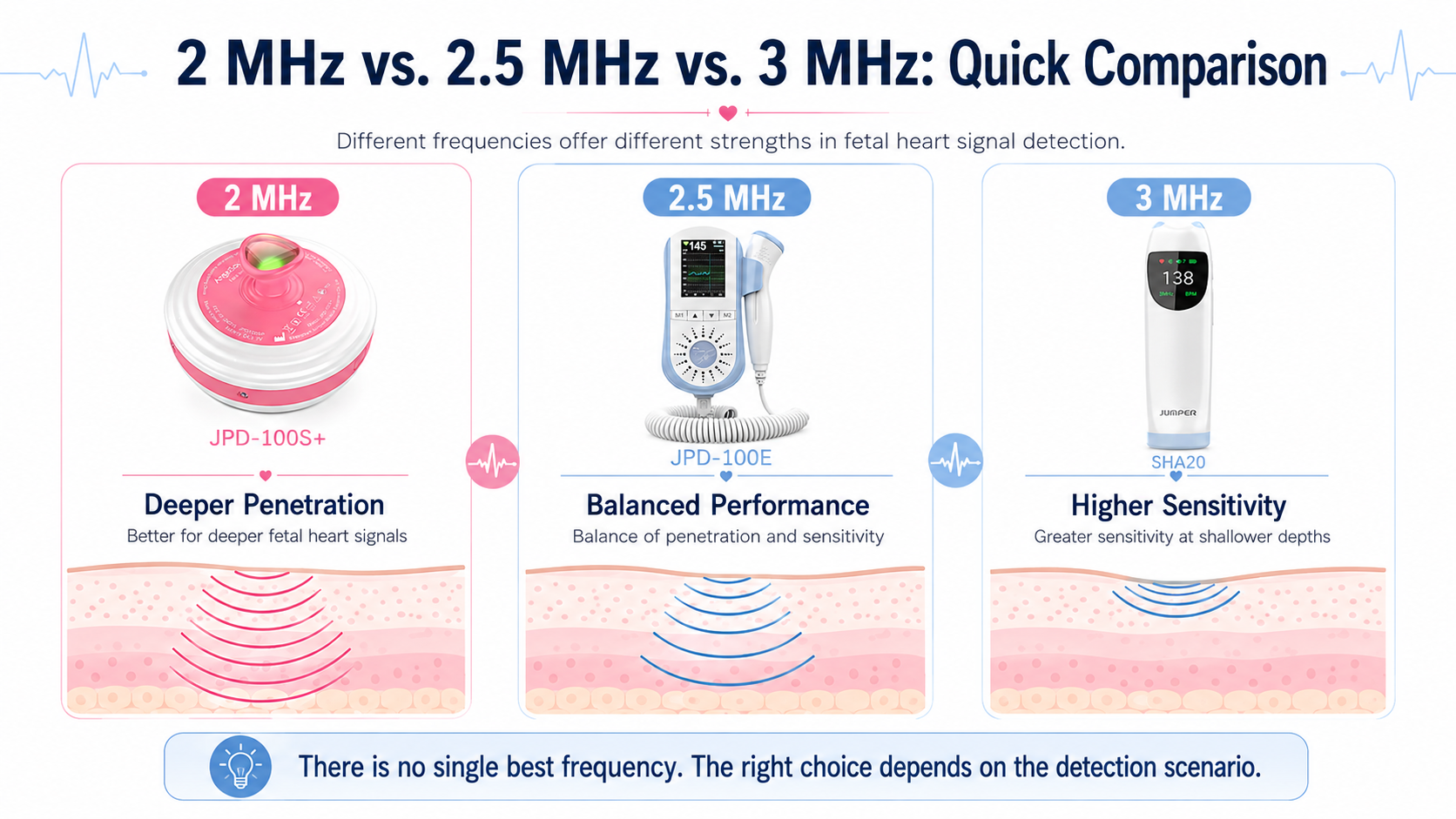
| Probe Frequency | Main Strength | Typical Characteristic |
|---|---|---|
| 2 MHz | Deeper penetration | Useful for deeper fetal heart signals |
| 2.5 MHz | Balanced performance | Balance between penetration and sensitivity |
| 3 MHz | Greater shallow-depth sensitivity | Often preferred for early gestation |
The key point is that these are general characteristics, not strict rules.
Gestational age alone should not be used to determine which Doppler frequency is “correct.”
Is 3 MHz More Accurate Than 2 MHz?
No.
A higher probe frequency does not automatically mean a more accurate fetal heart rate measurement.
Frequency primarily affects how ultrasound energy travels through tissue and how effectively signals can be detected at different depths.
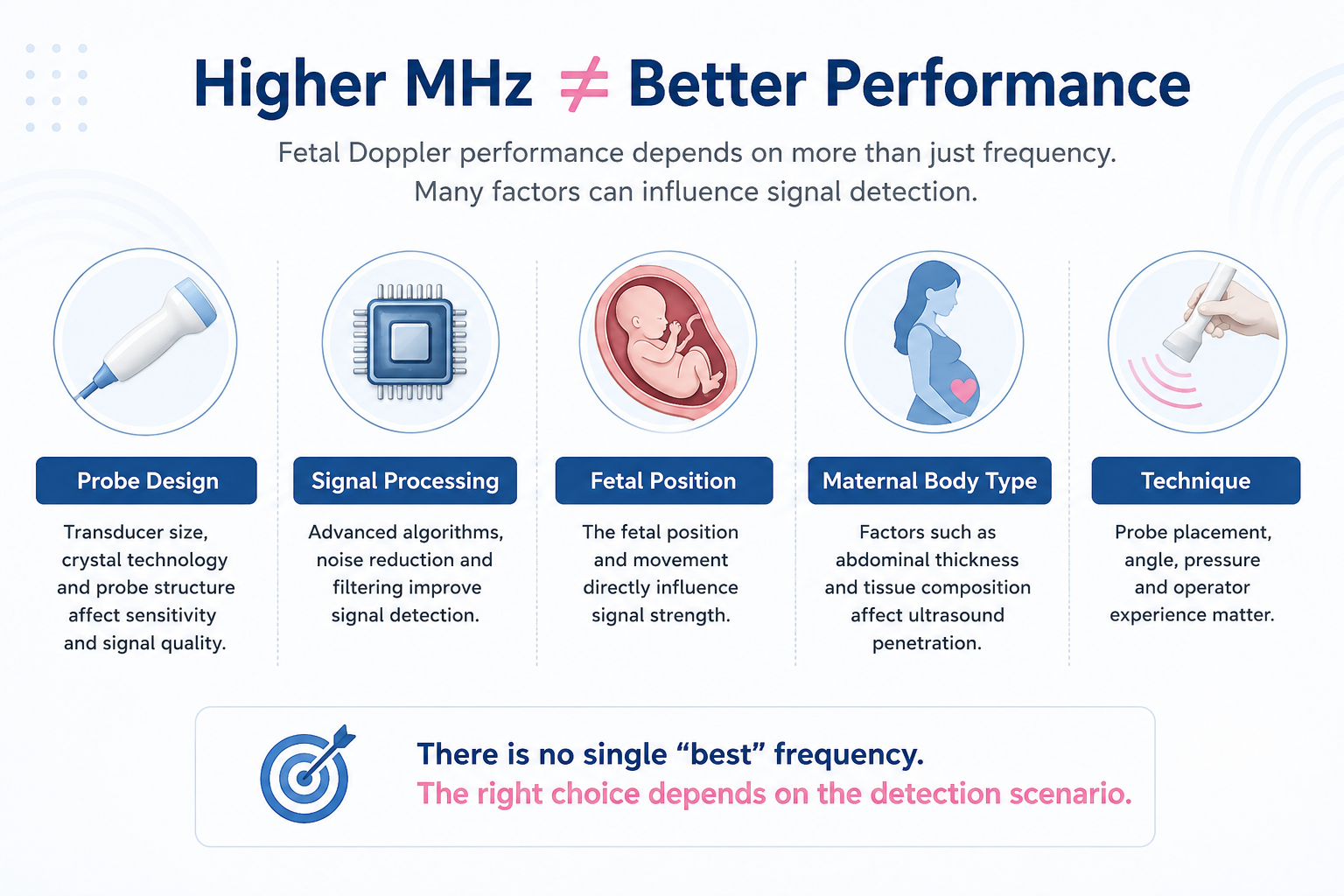
Actual fetal Doppler performance also depends on factors such as:
- Probe design
- Ultrasound transducer characteristics
- Signal-processing algorithms
- Receiver sensitivity
- Fetal position
- Maternal body type
- Probe placement and angle
- Operator technique
For example, Jumper offers fetal Doppler systems supporting both 2.2 MHz and 3.3 MHz obstetric probes, demonstrating that both frequencies remain relevant in modern fetal Doppler design.
Similarly, Huntleigh continues to offer both 2 MHz and 3 MHz high-sensitivity probes for different clinical situations, including early gestation and patients with higher BMI.
Therefore:
Higher MHz ≠ higher accuracy.
Why Is 3 MHz Common in Modern Fetal Dopplers?
3 MHz has become increasingly common, especially in compact and portable fetal Doppler products.
One reason is its strong sensitivity to fetal heart signals at relatively shallow depths, which can be advantageous when detecting small fetal movements during early gestation.
At the same time, improvements in:
- Ultrasound transducer technology
- Digital signal processing
- Noise reduction
- Signal amplification
- Fetal heart rate algorithms
have helped modern portable Dopplers achieve good performance across wider clinical scenarios.
However, the continued availability of both 2 MHz and 3 MHz professional probes shows that there is still no universal frequency that is ideal for every patient or every situation.
Can a 2 MHz Fetal Doppler Detect Early Pregnancy?
Potentially, yes.
A common misunderstanding is that because 3 MHz is often preferred during early gestation, 2 MHz cannot be used at that stage.
This is incorrect.
Some professional fetal Doppler systems using either 2 MHz or 3 MHz probes are intended for fetal heart screening from early pregnancy through labour. Huntleigh, for example, describes its SR series as suitable from approximately 8–10 weeks through labour, with either 2 MHz or 3 MHz configurations.
Whether a fetal heart signal can be detected at a particular point in pregnancy also depends on fetal position, maternal anatomy, device sensitivity, probe placement, and other factors.
Therefore, frequency should not be interpreted as a guaranteed gestational-age threshold.
Which Fetal Doppler Frequency Is Best?
There is no single “best” fetal Doppler frequency.
A more useful way to think about the three common options is:
2 MHz → Deeper penetration
2.5 MHz → Balanced penetration and sensitivity
3 MHz → Greater sensitivity at shallower depths
The appropriate choice depends on the intended application, product design, patient characteristics, and detection conditions.
For medical device manufacturers and healthcare professionals, probe frequency should therefore be considered as one component of overall fetal Doppler performance, rather than a standalone measure of quality.
The Bottom Line
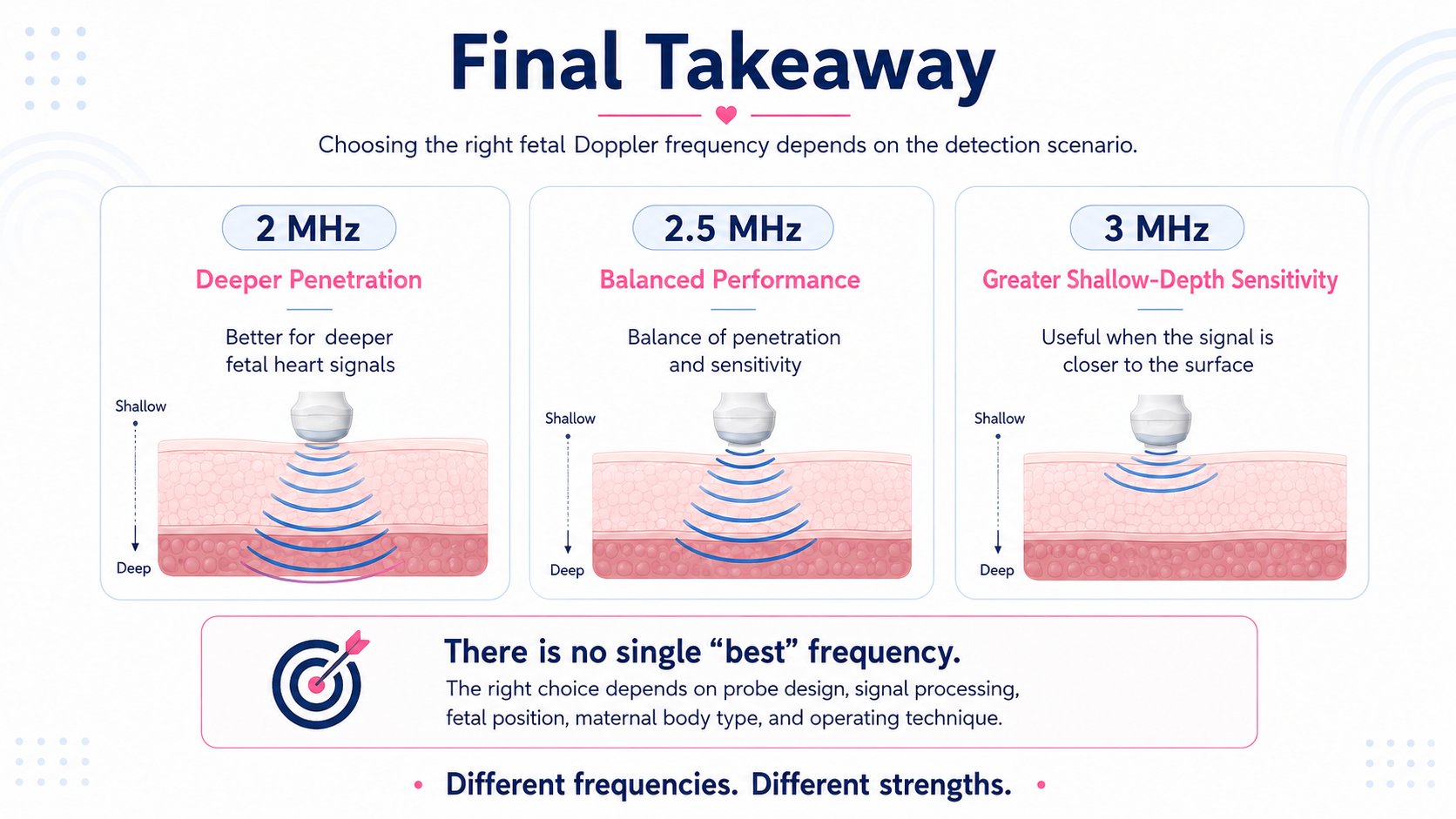
The difference between 2 MHz, 2.5 MHz, and 3 MHz fetal Dopplers is mainly about the balance between penetration depth and signal sensitivity.
A higher frequency is not automatically better, and a lower frequency is not automatically more accurate.
Instead:
2 MHz provides deeper penetration.
2.5 MHz provides balanced performance.
3 MHz provides greater sensitivity at shallower depths.
Ultimately, fetal Doppler performance depends on the complete system — including probe design, electronics, signal processing, fetal position, maternal anatomy, and operating technique.
Different frequencies. Different strengths. The right choice depends on the detection scenario.